Sorella Early Learning respectfully acknowledges the Kabi Kabi, Turrbal, and Jinibara peoples as the Traditional Custodians of the lands and waters of the City of Moreton Bay, on which our centre stands. We pay our deep respect to Elders past, present, and emerging, and acknowledge their enduring connection to Country, culture, and community.
At Sorella Early Learning in Griffin, we believe that every child deserves to grow up knowing the full story of the land they call home — a story that begins not in 1788, not in the naming of Griffin as a suburb, but tens of thousands of years before any of us arrived on this beautiful south-east Queensland earth.
The land on which Sorella stands, on which our children play and learn and grow every day, is the Country of the Kabi Kabi people — the Traditional Custodians whose connection to this region of south-east Queensland stretches back further than memory reaches. It is also the Country of the Turrbal and Jinibara peoples, recognised alongside the Kabi Kabi by the City of Moreton Bay as Traditional Custodians of the lands and waters across our region.
Long before Tesch Road was named, before Griffin was mapped, before any of our families moved to this suburb of low-set homes and wide streets and late-afternoon breezes — there were children here. Children who played. Children who ran, and threw, and caught, and laughed. Children whose games carried knowledge, whose play taught culture, and whose movement on Country was itself a form of learning.
At Sorella, we are committed to honouring that inheritance. Our Indigenous Games program is how we begin.
What Are Indigenous Games — And Why Do They Matter?
Indigenous games are not simply historical curiosities or novelty activities to bring out during NAIDOC Week. They are a living, sophisticated tradition — a body of knowledge about movement, community, skill, strategy, and the deep relationship between people and Country that has been passed down through countless generations of Aboriginal and Torres Strait Islander peoples across Australia.
The Queensland Government recognises this explicitly through its dedicated Burragun Games Trail resource, which documents traditional games played by Aboriginal and Torres Strait Islander peoples across Queensland. The word Burragun, from the Yugambeh language, means boomerang — itself a symbol of a game in perfect balance, going out and coming back, returning what it was given.
The Games Trail was developed in consultation with Indigenous communities and is grounded in almost every available historical account of Australian Aboriginal and Torres Strait Islander games. It is offered not as a replacement for genuine community engagement, but as a starting point for respectful learning — and as an invitation to discover that Australia’s play and sports culture is far older, far richer, and far more sophisticated than two centuries of European settlement have acknowledged.
For young children in early childhood settings, Indigenous games offer something uniquely valuable: they are play-based, inclusive, physical, cooperative, and deeply connected to Country. They are, in the truest sense of the Early Years Learning Framework (EYLF), learning through doing — exactly as children have always learned.
Buroinjin: The Game of the Kabi Kabi People
Of all the traditional games documented across Queensland, one holds particular significance for children at Sorella Early Learning: Buroinjin.
Buroinjin was a ball game played by the Kabi Kabi people — the Traditional Custodians of this very Country in south-east Queensland. The ball, called a buroinjin, was made from kangaroo skin, shaped and worked by hand into a round, solid sphere.
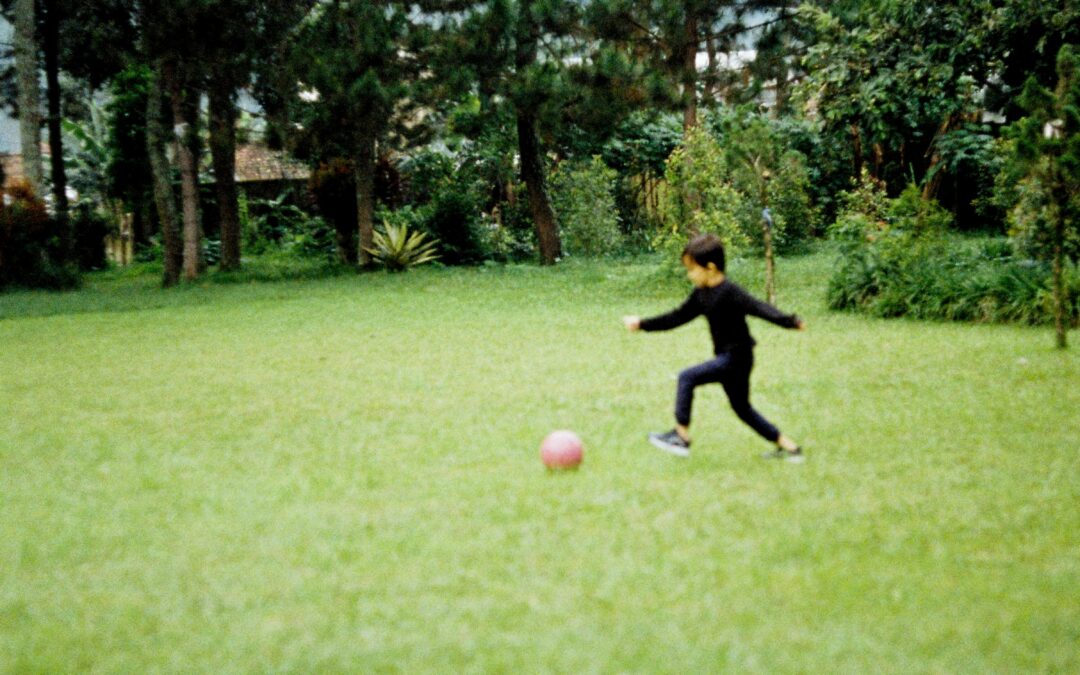
The game itself was played across an open field. Players from one team would attempt to run with the ball and cross to the other end without being touched by an opponent — a physical, fast-moving, whole-body game of agility, strategy, and teamwork. The Queensland Government’s Burragun Games Trail notes that the game was vigorous, joyful, and deeply communal — a game that brought players of all ages together in a shared physical and cultural experience.
For children at Sorella, a developmentally adapted version of Buroinjin is one of the most exciting outdoor movement experiences we offer — and one of the most meaningful. Because when our children run across our outdoor spaces on the Country of the Kabi Kabi people, they are not just playing a game. They are participating, however humbly, in a tradition that belongs to this place.
We introduce Buroinjin with care, with context, and — wherever possible — with the involvement of Kabi Kabi community members and Elders who can share the story of the game in their own voice and from their own authority.
More Games, More Stories: Traditional Play Across Queensland
Beyond Buroinjin, the Queensland Government’s Burragun Games Trail documents a rich variety of traditional Indigenous games from across Queensland and Australia. Here are some of the activities we draw upon in our program — each offered with respect, with context, and with the understanding that these games belong to their communities:
🌀 Waayin — Tracking and Observation
Waayin was derived from the study of animal and bird tracks — an essential part of educating Aboriginal children in the skills of observation, pattern recognition, and connection to Country. In our version, children follow tracks (drawn, pressed, or made with stamps) across our outdoor space, practising the deep attention and curiosity of the tracker. This is science, literacy, and cultural awareness all at once.
⚙️ Mer Kai — Keeping Up
In Mer Kai, a ball is kept in the air for as long as possible without touching the ground — similar to the game many children now know as hacky sack. It is a game of focus, coordination, persistence, and teamwork. In Torres Strait Islander tradition, players stood in a circle and sang the kai wed (ball song) as they played — connecting movement, music, and community in a single experience.
🎯 Weme — Rolling and Aiming
Weme is a rolling game in which balls are aimed underarm along the ground towards a target. It is a game of precision, patience, and spatial reasoning — and it is wonderfully accessible for children across a wide age range. The name comes from the Eastern Arrernte language and refers to throwing something at a target and hitting it.
🏃 Barambah Gimbe — Ball and Catch
Gimbe means “play” in the Wakka Wakka language — the language of another south Queensland First Nations people. Barambah gimbe involves throwing a ball high into the air and attempting to catch it — a game of anticipation, timing, and physical coordination. Hearing and using language words from south Queensland’s First Nations peoples in our play is a small but genuine act of cultural recognition.
How We Approach This Work at Sorella
Let us be clear about something important: embedding Indigenous games into our program is not something we do once a year and then consider complete. It is not a theme week. It is not a display on a wall. And it is never done without genuine cultural guidance and community partnership.
The Queensland Department of Education’s Cultural Capability Framework sets out clear expectations for early childhood services: that we develop genuine, ongoing relationships with Aboriginal and Torres Strait Islander families, communities, and Elders; that we approach cultural work with flexibility and a willingness to be guided; and that we foster local decision-making and co-design rather than imposing our own interpretations of culture from the outside.
At Sorella, this means:
- Genuinely inviting Kabi Kabi, Turrbal, and Jinibara community members to be part of how we introduce and share Indigenous games and cultural activities
- Using only culturally appropriate activities — the Queensland Government’s Burragun Games Trail resource specifically avoids games used in initiation ceremonies or religious events, and we follow this guidance carefully
- Contextualising every game so children understand whose game it is, where it comes from, and why it is significant
- Approaching this as an ongoing journey, not a completed task — always open to feedback, always willing to learn, always humble about what we do not yet know
The goal is not cultural performance. The goal is genuine, respectful, living cultural connection — for every child in our care, regardless of whether they are Aboriginal or Torres Strait Islander, and regardless of where their family came from to reach Griffin.
Why Indigenous Games Matter for All Children
Cultural education through play belongs to every child — not just Aboriginal and Torres Strait Islander children. In fact, the Queensland Department of Education is explicit that embedding Aboriginal and Torres Strait Islander perspectives in early childhood education is as important for non-Indigenous children as it is for Indigenous children.
When all children play Buroinjin, when they learn to say gimbe (play) in Wakka Wakka, when they learn that the land they run on has a history older than written record — they are developing:
- Cultural awareness and respect — a foundation for the kind of inclusive, empathetic, reconciliation-minded Australians our children deserve to become
- Physical literacy — Indigenous games develop the same gross motor skills, coordination, balance, and physical confidence as any other movement program, while adding layers of cultural meaning
- Mathematical and scientific thinking — tracking, aiming, catching, pattern recognition and spatial reasoning are woven through these games naturally
- Language development — hearing and using words from south Queensland’s First Nations languages builds phonological awareness and a genuine sense of the diversity and richness of Australia’s linguistic heritage
- Social and emotional development — cooperative, inclusive, non-competitive play builds empathy, teamwork, and a genuine sense of community
And for Aboriginal and Torres Strait Islander children in our care — seeing their culture reflected in our games, our language, our stories, and our outdoor spaces is an affirmation of identity and belonging that the Queensland Government’s early childhood resources recognise as fundamental to every child’s sense of self.
Extending the Learning: Playing Together at Home in Griffin
The spirit of Indigenous games can extend beyond our centre into the parks, backyards, and streets of the Griffin community. Here are some simple, joyful ways to explore these ideas at home:
- Play Barambah Gimbe — Take a soft ball to your local park, throw it as high as you can, and try to catch it. Call out “gimbe!” (play) when you throw. This is it. That’s the game. That is 10,000 years of play culture alive in your backyard.
- Go tracking — Walk through your local park and look for tracks: birds in mud, insects in sand, the impression of a bicycle tyre. Talk about what made each mark. This is the art of the tracker — one of the oldest and most sophisticated human skills there is.
- Visit the Burragun Games Trail — The Queensland Government has documented traditional Indigenous games in a publicly accessible resource online. Explore it together as a family. Choose a game to try. Let your child be the expert.
- Learn a word in Kabi Kabi language — The Kabi Kabi People’s Aboriginal Corporation (kabikabination.com.au) is the representative body for the Kabi Kabi people whose Country we live on. Learning even a single word of the language of the Country you live on is an act of respect that takes moments and lasts a lifetime.
- Acknowledge Country together — Before you head outside to play, take a quiet moment together and acknowledge that you are playing on the Country of the Kabi Kabi, Turrbal, and Jinibara peoples. Explain what this means in words your child can understand. This is the most important game of all — the practice of paying attention to where you are and who was here before you.
The EYLF and Indigenous Games: Learning Through Every Outcome
Our Indigenous Games program is grounded in the Early Years Learning Framework (EYLF) V2.0 across all five learning outcomes:
- Outcome 1 – Strong sense of identity: For Aboriginal and Torres Strait Islander children, seeing their culture’s games played with respect in our setting affirms who they are. For all children, engaging with the games of this Country builds a sense of belonging to place — to Griffin, to the Moreton Bay region, to Australia.
- Outcome 2 – Connected to their world: The Queensland Government’s early childhood resources describe this outcome as children observing, exploring, and building their understanding of the world’s diversity. Indigenous games are a direct, living expression of cultural diversity — not in a textbook, but in the child’s own moving, laughing body.
- Outcome 3 – Strong sense of wellbeing: Physical activity, joy, inclusion, and belonging — Indigenous games deliver all of these, supporting children’s physical health and emotional resilience simultaneously.
- Outcome 4 – Confident and involved learners: Tracking, pattern recognition, spatial reasoning, motor skill development, and the kind of focused, purposeful inquiry that Indigenous games naturally inspire are all central to this outcome.
- Outcome 5 – Effective communicators: Hearing words from Kabi Kabi, Wakka Wakka, and other south Queensland languages, learning the names and stories of games, and sharing what they have discovered with their families all build the rich, multidimensional communication skills of EYLF Outcome 5.
A Note on Doing This Well
We want to say, clearly and honestly, that this work requires ongoing humility.
Sorella Early Learning opened in September 2023. We are a young centre on ancient Country. We are still learning. We do not claim to have arrived at a perfect cultural program — we claim to be genuinely, earnestly trying to get it right, in partnership with the communities whose knowledge and whose Country we are privileged to share.
If you are a Kabi Kabi, Turrbal, or Jinibara community member, or an Elder from any part of south-east Queensland’s First Nations communities — we genuinely, warmly, sincerely welcome your voice in shaping how we do this work. Please reach out. Our doors — and our hearts — are open.
Enquire and Enrol
📍 32 Tesch Road, Griffin QLD 4503 📞 07 2111 6711 ✉️ enrolments@sorellaearlylearning.com.au 🌐 sorellaearlylearning.com.au 🕐 Open Monday – Friday, 6:30am – 6:30pm
Sources
The following Queensland-based and nationally recognised early childhood and cultural sources were used in the research and writing of this blog post. No other early childhood or childcare services have been cited as sources.
- Queensland Government – Traditional Indigenous Games Trail (Burragun Games Trail) qld.gov.au – Traditional Indigenous Games Trail — A Queensland Government resource documenting traditional games played by Aboriginal and Torres Strait Islander peoples across Queensland, developed in consultation with Indigenous communities. Specifically references the Buroinjin ball game of the Kabi Kabi people of south Queensland.
- City of Moreton Bay – Traditional Custodians Information ourstory.moretonbay.qld.gov.au – Traditional Custodians — The City of Moreton Bay’s official acknowledgement of the Kabi Kabi, Jinibara, and Turrbal peoples as the Traditional Custodians of lands and waters throughout the City of Moreton Bay, including Griffin, QLD.
- Queensland Department of Education – Aboriginal and Torres Strait Islander Cultural Capability Framework education.qld.gov.au – Cultural Capability Framework — The Queensland Department of Education’s framework outlining the responsibilities of early childhood services in developing genuine, respectful relationships with Aboriginal and Torres Strait Islander communities, Elders, and families.
- Queensland Department of Education – Resources for Aboriginal and Torres Strait Islander Communities earlychildhood.qld.gov.au – Resources for ATSI Communities — Queensland Government early childhood resources including the Ngana Waguna Woori Mumba artwork and Elders as Storytellers resources, connecting culture, Country, and early learning.
- Queensland Government – Early Childhood Education qld.gov.au – Early Childhood — Queensland Government information on the Early Years Learning Framework (EYLF V2.0), Queensland Kindergarten Learning Guidelines, and embedding Aboriginal and Torres Strait Islander perspectives in early childhood education.
- Queensland Government – Resources for Parents and Families qld.gov.au – Resources for Parents — Queensland Government guidance for families on supporting children’s learning, cultural awareness, and connection to Country through everyday activities.
- Early Childhood Australia – Queensland Committee earlychildhoodaustralia.org.au – Queensland Branch — Queensland’s peak advocacy body for early childhood education and care, providing research, resources, and guidance on embedding First Nations perspectives, cultural education, and reconciliation in early childhood settings.
- Kabi Kabi People’s Aboriginal Corporation kabikabination.com.au — The representative body for the Kabi Kabi people, the Traditional Custodians of the Country on which Sorella Early Learning stands, including the preservation and sharing of Kabi Kabi culture, language, and heritage.
Sorella Early Learning is a family-owned, purpose-built early learning centre in Griffin, QLD, dedicated to nurturing and empowering every child to blossom into their best selves. We welcome children from 6 weeks to school age, Monday to Friday, 6:30am to 6:30pm. We are committed to embedding genuine, respectful, and ongoing cultural education across everything we do. To enquire about enrolment or to share your cultural knowledge with our team, please contact us today.